Date Published: 06/07/2026
Today Earth is at its farthest point from the Sun. So why is Spain sweltering?
ARCHIVED ARTICLE -
The planet reaches aphelion on Monday July 6, a cosmically counterintuitive moment that coincides with temperatures pushing well above 40°C across parts of the country
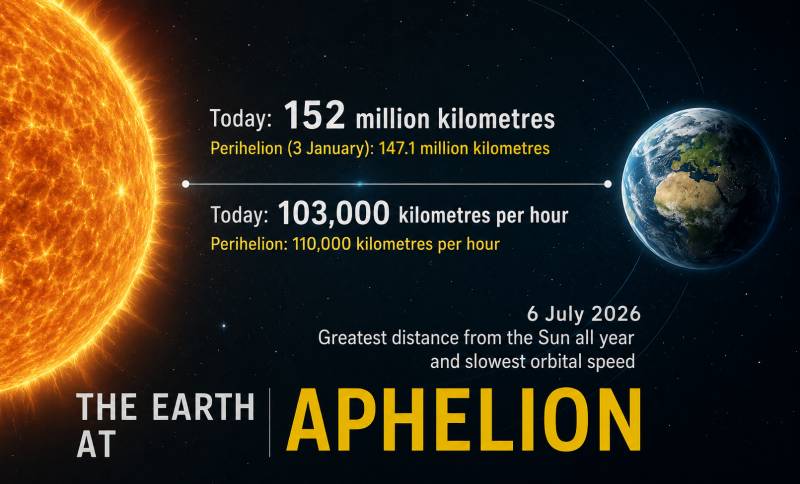
Here's a fact that sounds like it belongs in a pub quiz rather than real life. Today, Monday July 6, Earth is at aphelion, the point in its yearly orbit where it sits at the greatest possible distance from the Sun. That's around 152 million kilometres away, some 5 million kilometres further than we were back in January. And
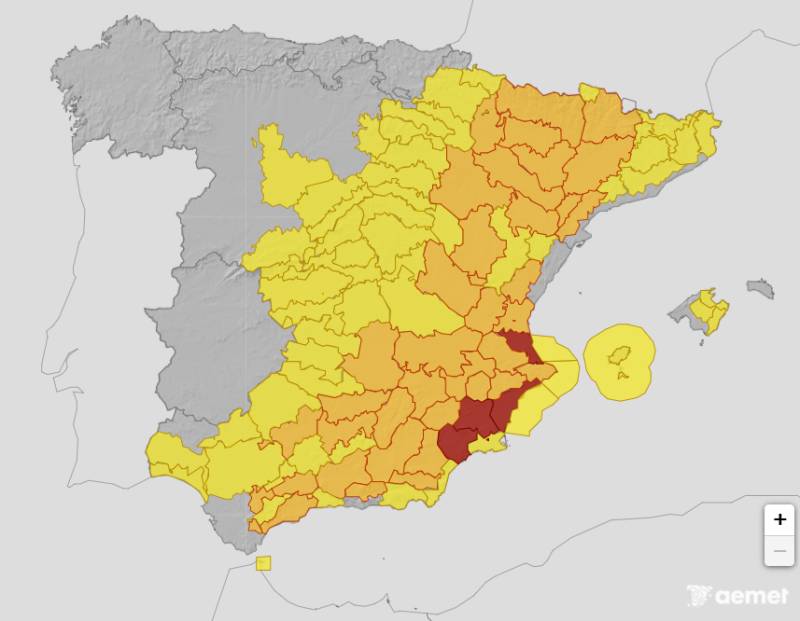
Spain is currently under an orange heat alert with temperatures forecast to exceed 40°C tomorrow. You couldn't make it up.
Aphelion comes from the ancient Greek: apo meaning far, and helios meaning the Sun. Its opposite, perihelion, is the point where Earth swings closest to our star, which happens, slightly bafflingly, in early January. So we're nearest the Sun in the depths of winter and furthest away in the height of summer. The universe has a sense of humour.
The reason none of this translates into cooler temperatures is that seasons have nothing to do with distance. It's all about tilt. Earth orbits at a 23.5 degree axial tilt, and right now the northern hemisphere is angled directly towards the Sun. That's what drives summer.
As Roy Spencer at NASA's Global Hydrology and Climate Center explains: "We're closer to the Sun in January, but the extra sunlight gets spread throughout the oceans." The average global temperature at aphelion is actually around 2.3°C higher than at perihelion, because more of Earth's landmass sits in the northern hemisphere and heats up faster. So being further away makes us hotter overall. Wonderful.
We have Johannes Kepler to thank for figuring out the elliptical orbit business back in 1609, when he proved the planets don't travel in perfect circles but in elongated ellipses, with the Sun at one focal point. The Catholic Church wasn't thrilled. One curious consequence of that elliptical path is that northern hemisphere summers last about five days longer than winters, because Earth moves fractionally slower when it's further from the Sun. Every cloud.
As for the heat itself, Spain is in the grip of a mass of very hot, dry air that isn't going anywhere quickly. Today brings a yellow warning with highs of 37°C, but Tuesday July 7 steps it up to orange, with inland areas expected to hit above 40°C in the shade at midday. Orange alert means serious potential impacts for vulnerable groups, so if you have elderly relatives or young children, keep a close eye on them, keep everyone hydrated, and save any outdoor exertion for the morning or evening.
The good news, if you can call it that, is that Earth won't always reach aphelion in summer. These dates drift by roughly one day every 58 years. By the year 6,430, perihelion will fall on the March equinox. Until then, the laws of orbital mechanics and the Spanish summer will continue to do exactly as they please.
article_detail

|
staff.inc.and
Address
Casas del Puente 3, Cartagena, Murcia, Spain, 30397
Tel: +34 623 140 902
Loading
The Astronomy and Science Centre Foundation has star-themed events and activities to delight novices and experts of all ages
Astronomy Tours runs a whole host of astronomical activities and events in the Murcia Region, from astronomical observation sessions to a magical cruise under the stars, to really fire up an interest in the cosmic world beyond our atmosphere.
Their main base of operations is the Finca Astronomica, located close to the town of La Aljorra in the Campo de Cartagena, where you can join their astronomy tours either in the daytime or at night, all year round.
At the Finca, you’re welcomed with delicious food, drinks, a bonfire and a variety of astronomical tools and gadgets. In the summer season, they also have tours in other locations, including San Pedro del Pinatar, La Manga and Camposol, not to mention their unmissable cruise under the stars, which involves a nighttime cruise on the Mar Menor with tapas and drinks, plus a guided presentation of the night sky as you watch the galaxy glide by.
The Astronomy Tours and the Finca Astronomica are supported by the Astronomy and Science Centre Foundation, which was founded in 2019 by a group of astronomers and Starlight-certified guides and monitors in the astronomical observatories in Spain.
The purpose of the Foundation is to promote the knowledge and interest in the field of astronomy and astronomy-related sciences, which covers areas such as physics, chemistry, biology, geology, but also history, archeology, urban and medical aspects of social life, literature, art, culture and (of course) astrology.
By promoting this knowledge and getting their customers interested in astronomy, the Foundation hopes to achieve higher goals such as bringing the stars a little closer to people, and helping them to understand the importance of caring about our planet and the whole human population as a one.
To achieve those goals, the Foundation organises its day- and nighttime activities and camps which are suitable for both children and adults, and as well as this they work with
schools and organisations and write books for children to bring astronomy to the masses.
As part of this mission, they’re creating an astronomically themed park right on the Costa Cálida called the Astronomy and Science Centre which has an observatory available to the public to see the stars and the planets, and where they also promote ecofriendly and sustainable activities and closeness to nature.
The Finca Astronomica even has its own friendly and well cared for animals which live in really big spaces where people can easily enter and interact with them in their own environment.
What’s more, you can get involved in all sorts of other fun and activities for all the family at the Finca Astronomica, including glamping under the stars, stroking the animals at their petting zoo and enjoying sports like darts, archery, nerf gun fights, and many more.
This year, Finca Astronomica is excited to unveil its very own Yurt Village. Alongside the beautifully crafted wooden glamping pods, the yurts combine traditional charm with all the modern comforts including double beds, cosy carpets and plenty of shelving for your personal belongings.
But that’s not all. Each yurt comes handily equipped with light and electricity, so that you can charge your devices even as you recharge your spirit under the vast, starry sky.
This summer season is about to come alive with regular tours happening three days a week, while Adult Only Fridays are just around the corner.
Tours are available in English, Spanish and Polish.











 Spanish News Today
 Murcia Today
 Alicante Today