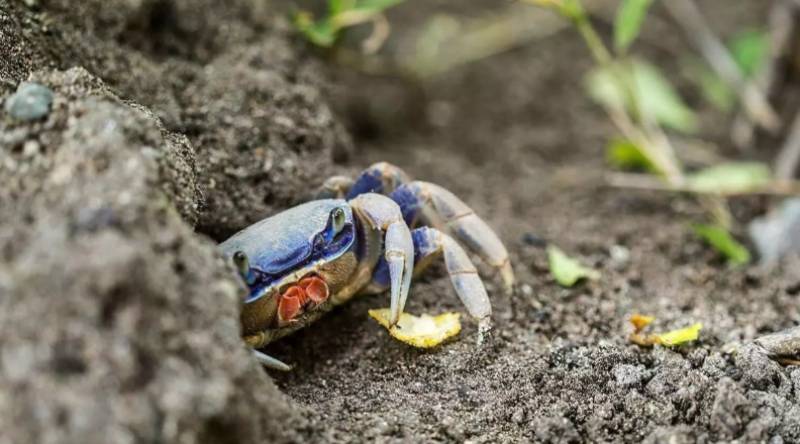
Octopus army released in Italy to fight blue crab invasion: Could Spain be next?
As blue crabs continue to spread across Spanish coastlines, wetlands and estuaries, a project in Italy is using octopuses to try to bring the invasive species under control
The blue crab is one of several invasive species putting pressure on Spanish waters, spreading across large stretches of coastline, wetlands and other ecosystems and pushing out native species as it goes. Over in Italy, they may have stumbled on a natural solution to the same problem, one that's been wreaking havoc on the country's fishing industry.
A team from the University of Bologna believes the common octopus could hold the key to keeping blue crab numbers in check, and they've begun releasing thousands of the cephalopods into the Adriatic Sea in a bid to protect local fishing livelihoods.
Researcher Antonio Casalini explained that they'd settled on the octopus because in its natural habitat, it's a formidable predator of crustaceans.
Blue crabs are originally from the Atlantic coast of North America and are thought to have reached the Mediterranean decades ago, most likely carried over in ships' ballast water. Their numbers have shot up in recent years, with both the government and local fishermen pointing to warming waters and climate change as the main drivers behind the surge.
Authorities in the Emilia-Romagna region, where Bologna is located, revealed last year that the crabs have caused close to €17 million worth of damage since 2022.
According to estimates from aquaculture and fishing group Coldiretti, there are now around 200 million blue crabs across Italy. Fisherman and mussel farmer Davide Sanulli, who's involved with the university project, said the crab eats everything, even the young clams living on the seabed. In the lagoon areas of the Po River delta, the 64-year-old added, it's caused a massacre.
The crabs are strong swimmers and can weigh up to 1kg, and with few natural predators to keep them in check, researchers are hoping that releasing large numbers of octopuses into the sea will help tip the balance.
The scheme, known as the Octo-Blu project, was launched last year with funding from the Emilia-Romagna region and aims to grow the octopus population as a counterweight to the invasive crabs.
The research team raises huge numbers of octopus larvae in tanks at a laboratory in the port town of Cesenatico. Once they've grown large enough, the young octopuses are gathered up by the thousands, placed into large plastic bags and released into the sea near underwater reefs, where the team has built artificial shelters out of cement and clay to help them settle and grow.
Since June, around 80,000 octopuses have been released, and the team is hoping to double that number by the end of August, with the aim of as many as possible surviving into adulthood.
Casalini, an aquaculture technician, explained that the idea is to build a small community of octopuses near the coast that can help fight back against the spread of the blue crab.
The project isn't without its challenges though. The common octopus doesn't typically live in the warm, sandy waters found in the lagoons where blue crabs cause the most damage, which limits how effective the strategy can be in those areas.
Some experts reckon sea bass could actually do a better job of tackling the crabs, and the Bologna team is also looking into eels, which feed heavily on crustacean eggs, as a way of supporting the octopuses' efforts.
Fellow researcher Pietro Emmanuele pointed out that blue crabs have an incredible reproductive potential and a high fertility rate, with a single female laying millions of eggs, the majority of which go on to hatch. Only a small number of those offspring ever make it to adulthood, but even so, every female an octopus manages to catch could make a real difference to the numbers further down the line.













 Spanish News Today
 Murcia Today
 Alicante Today